
Deep dive
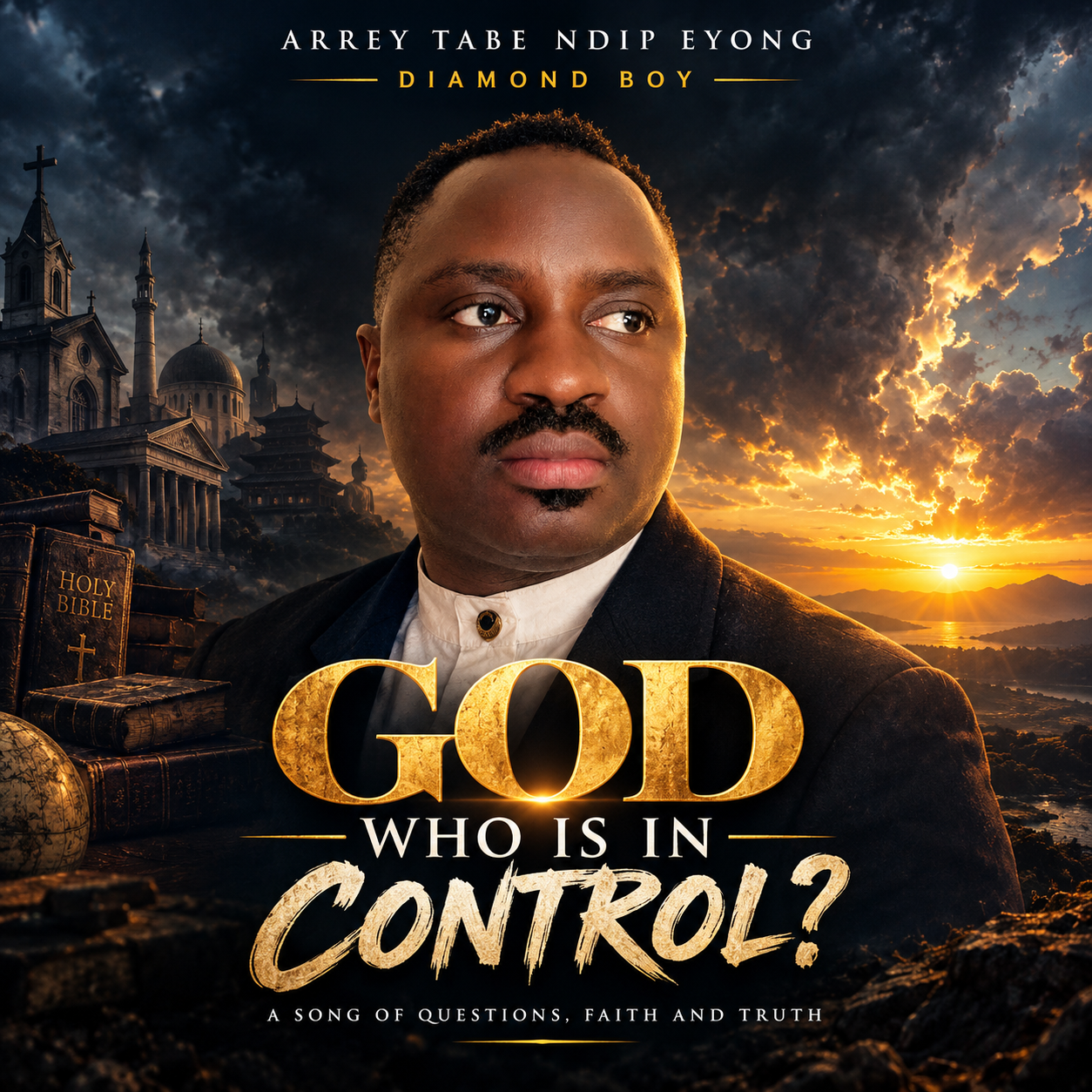
There are questions a person carries quietly for years before finally saying them out loud. For Arrey Tabe Ndip Eyong — the artist the world knows as DIAMOND BOY — that question has become a whole song: “God, who is really in control?”
Throughout human history, people have believed in God, worshipped different deities, built temples and churches, written sacred books, and established religious doctrines. Each tradition has developed its own understanding of God and the correct way to worship.
“GOD WHO IS IN CONTROL?” asks how human beings can be certain that their understanding of God represents the complete truth. It challenges listeners to think beyond inherited beliefs and examine the foundations of their faith. It does not deny God’s existence; instead, it questions the certainty with which people claim to understand God.
The central concern is the difference between God as a possible ultimate reality and human interpretations of God. The song invites listeners to think rather than simply accept what they have been told.
What Have We Really Been Told About God?
The lyrics begin with beliefs that people often inherit from their families, communities, religious leaders and sacred traditions.
From childhood, many people are taught that God sees everything, knows everything, protects the faithful, rewards righteousness, and punishes wrongdoing. For many believers, these teachings provide hope, moral guidance and comfort during difficult times.
But the songwriter raises a deeper question: Do people believe these things because they have independently examined them, or because they were taught to believe them? This is not an accusation against religion. It is an invitation to distinguish personal conviction from inherited certainty.
The deeper message is that faith should be something people understand and reflect upon, rather than something they follow blindly out of fear or social pressure.
The Conflict Between Different Religions
Different religious communities often claim to possess the truth. Some worship in churches, others in mosques, temples or other sacred places. Some understand God as a personal being, while others understand ultimate reality differently. Even within the same religion, believers disagree about doctrines, sacred texts and the correct way to worship.
This creates a philosophical problem: if different people sincerely believe their religious understanding is correct, how should they evaluate conflicting claims? The song does not declare one religion right and another wrong. Instead, it encourages listeners to examine why people hold their beliefs and how certainty develops.
It also asks whether human beings sometimes confuse their understanding of God with God himself. Understanding a concept of God is not necessarily the same as knowing everything about God. This distinction is essential to the song’s message.
The Problem of Human Suffering
The question becomes even more powerful when we consider human suffering. If God is all-powerful, all-knowing and perfectly good, why do innocent people suffer? Why do children die from preventable diseases? Why do families experience devastating losses? Why do wars destroy communities? Why do hardworking people sometimes struggle while dishonest people prosper?
These questions form part of a longstanding philosophical problem known as the problem of evil. Different religious and philosophical traditions offer different explanations. Some emphasize human free will, others spiritual growth, the limitations of human understanding, or the natural order of the universe. None of these explanations is accepted by everyone.
The song’s power lies in allowing the questions to remain meaningful instead of rushing to provide easy answers:
If You see the tears of a mother, Why does her child still cry? If You can silence the thunder, Why does the innocent die?
Who Is Really in Control?
This is the central question of the entire composition — and the title can be interpreted in several ways.
Is God in control of everything?
If God determines everything that happens, questions arise about human responsibility. If every event is predetermined, how much freedom do human beings possess? If people are genuinely free to choose their actions, does that mean some events occur outside God’s direct control? Philosophers and theologians have debated these questions for centuries.
Are human beings claiming too much authority in God’s name?
Religious leaders, institutions and ordinary believers sometimes make confident statements about what God wants. The song questions whether such claims always represent divine truth, or sometimes reflect human interpretations, ambitions, fears and interests. Questioning someone’s claim to speak for God is not the same as questioning God’s existence.
Is humanity confusing control with understanding?
Human beings have achieved extraordinary scientific and technological progress, yet many fundamental questions about existence remain unresolved. We can investigate the universe, study the origins of life and explore the physical laws governing nature. Nevertheless, questions about ultimate purpose, consciousness, morality and the existence of God remain subjects of philosophical, scientific and theological discussion.
Perhaps the song’s most important challenge is not simply to ask who controls the universe, but to ask whether human beings truly understand what control means.
The Emotional Meaning of the Song
Although the song explores intellectual questions, it is not a classroom lecture. Its emotional strength comes from the experience of someone who has spent years listening to religious explanations but still carries unanswered questions.
The narrator believes, doubts, hopes, fears and searches — all at the same time. That makes the song relatable to anyone who has experienced religious confusion, personal tragedy, disappointment or a crisis of faith.
Some listeners may hear it as a challenge to religion. Others may hear it as an expression of sincere spiritual searching. Still others may interpret it as a call for religious humility. That range of interpretations is one of the song’s greatest strengths.
The narrator is not claiming to possess the answer. He is asking why humanity is so confident that it already has one.
A Sound Built for Reflection: 68 BPM
The slow tempo of 68 BPM shapes the song’s contemplative atmosphere. Soft piano, a deep atmospheric pad and distant wind create a sense of loneliness and contemplation — like someone thinking aloud late at night, confronting questions that have occupied their mind for years. Each question is given space.
A gentle, heartbeat-like kick introduces vulnerability. The vocals sit low, intimate and conversational, as though the artist is speaking directly to the listener. In the chorus, the question “God, who is in control?” returns with layered backing vocals, so that the narrator’s personal question becomes a question shared by humanity. The bridge rises into a passionate appeal for truth, and the outro fades into a whispered repetition — “Who is really in control?” — followed by silence that lets the question linger.
What Makes This Song Different?
Intellectual courage — it addresses difficult questions that people may hesitate to discuss openly.
Emotional honesty — it allows uncertainty to exist without treating it as weakness.
Universal relevance — believers, skeptics and the undecided can all engage with its central questions.
Philosophical depth — it explores the distinction between divine reality and human interpretations of that reality.
Artistic freedom — it does not promote a particular religious institution or insist that every listener reach the same conclusion.
The song avoids portraying religious people as ignorant or dishonest. Many believers have seriously examined their convictions, and many traditions carry rich histories of philosophical debate. The aim is to challenge unquestioned certainty — not to insult anyone for what they believe.
The Ultimate Message
At its deepest level, the song is about humanity’s search for truth. It asks whether people can acknowledge the limits of their knowledge while continuing to seek meaning, whether faith can coexist with difficult questions, and whether humility might be more valuable than pretending to possess absolute certainty.
It also draws a line between questioning God and questioning the human beings who claim to understand or represent God. A person can question religious institutions while remaining a believer. Another can question the existence of God without rejecting morality or compassion. Someone else can remain uncertain while continuing to search. The song leaves room for all three.
If humanity has spent thousands of years trying to understand God, how much do we truly know — and how much have we simply assumed?
That is the question at the heart of DIAMOND BOY’s song.
What do you think?
Join the conversation
What does this idea reveal to you—and where do you see it differently?
Sign in through your account to add a response. Reading remains open to everyone.
Join the Human Voice newsletter
Join us for exclusive ideas, stories, music and new releases.
No spam. Unsubscribe anytime.
About the creator
Created by Arrey Tabe Ndip Eyong
Original human ideas shaped into stories, music, writing and visual experiences.
Meet the creator